

-
Research Article
-
Educational Effects of a Persona-Chatbot-Based Virtual Resident Interview Program: Focusing on AI Literacy and Empathy Toward Residents of Other Regions
페르소나 챗봇 기반 가상 지역 주민 인터뷰 프로그램의 교육적 효과: AI 리터러시와 타지역 주민 공감 능력을 중심으로
-
Euihyun Park
박의현
- This study examined the effects of a persona-chatbot-based virtual resident interview program on middle school students’ AI literacy and empathy toward residents …
본 연구는 페르소나 챗봇 기반 가상 지역 주민 인터뷰 프로그램이 중학생의 AI 리터러시와 타지역 주민 공감 능력에 미치는 영향을 혼합연구 설계를 통해 …
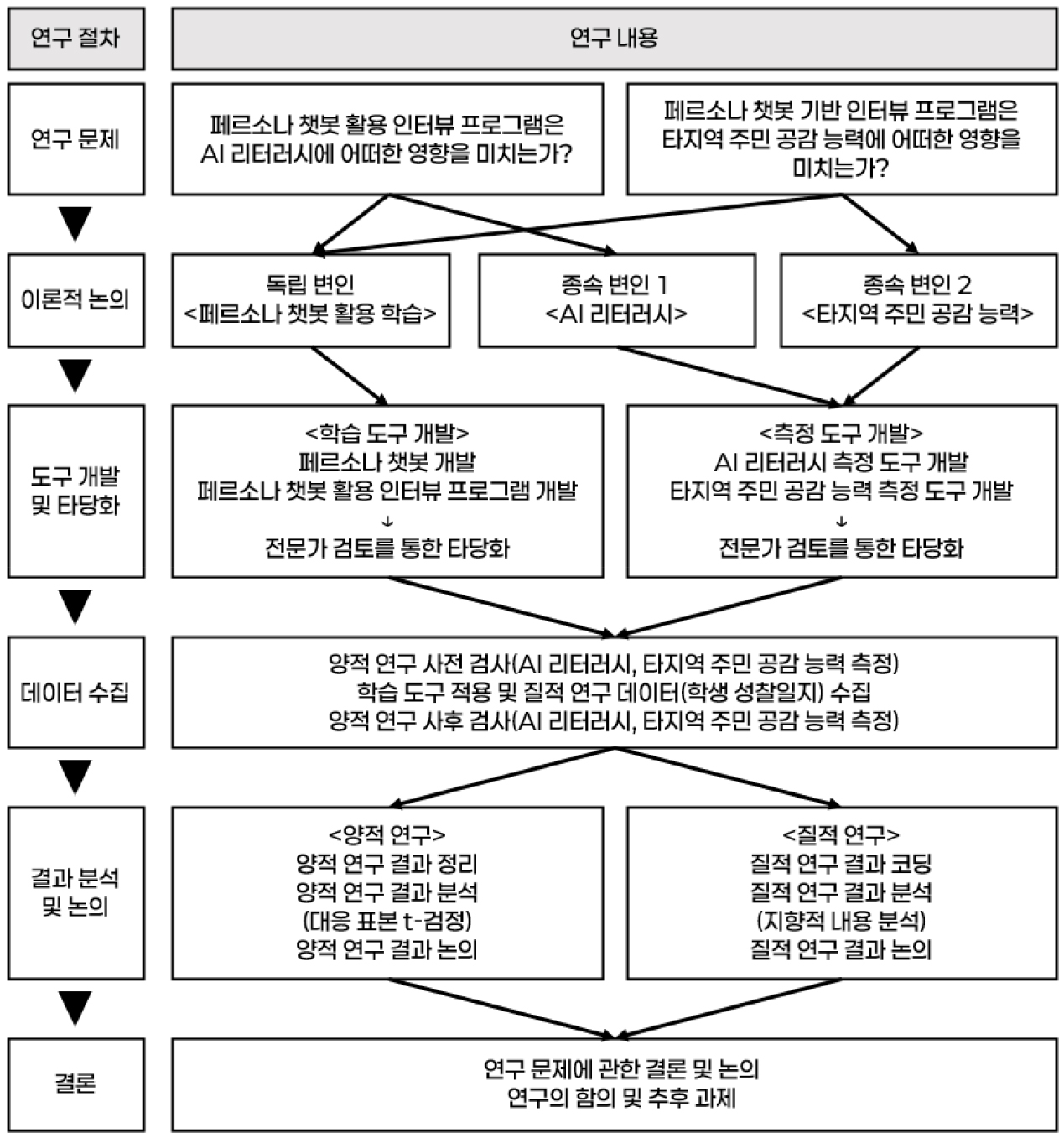
- This study examined the effects of a persona-chatbot-based virtual resident interview program on middle school students’ AI literacy and empathy toward residents of other regions using a mixed-methods design. To this end, an instructional program consisting of “interviewing–fact-checking–article writing” was developed, along with measures of AI literacy and empathy toward residents of other regions. The program was implemented with 174 middle school students, who participated in virtual resident interview activities focusing on Europe and Africa over a total of eight class sessions. Pre- and post-test data and student reflection journals were analyzed. The quantitative results showed statistically significant improvements in both AI literacy and empathy toward residents of other regions. The qualitative findings indicated that, through interactions with the chatbots, students developed an understanding of how to use AI and recognize its potential for error. They also came to perceive residents of other regions as individuals with concrete lived experiences and to understand their lives in relation to regional environments. This study is significant in that it developed and evaluated an instructional program using persona chatbots based on the Korean national curriculum and demonstrated the potential of persona chatbots for use in geography education.
- COLLAPSE
본 연구는 페르소나 챗봇 기반 가상 지역 주민 인터뷰 프로그램이 중학생의 AI 리터러시와 타지역 주민 공감 능력에 미치는 영향을 혼합연구 설계를 통해 검증하였다. 이를 위해 ‘인터뷰하기–팩트체크하기–기사 작성하기’로 구성된 프로그램을 개발하고, AI 리터러시와 타지역 주민 공감 능력 측정 도구를 개발하였다. 중학생 174명을 대상으로 유럽 지역 주민과 아프리카 지역 주민 인터뷰 프로그램을 각각 적용하여 총 8차시의 수업을 실시하고, 사전·사후 검사와 성찰일지를 분석하였다. 양적 분석 결과, AI 리터러시와 타지역 주민 공감 능력이 모두 통계적으로 유의하게 향상되었다. 질적 분석 결과, 학생들은 챗봇과의 대화 과정에서 AI의 활용 방법과 오류 가능성을 이해하였으며, 타지역 주민을 구체적인 삶을 살아가는 개인으로 인식하고 그들의 삶을 지역 환경과 연계하여 이해하는 모습을 보였다. 본 연구는 우리나라 교육과정에 기반하여 페르소나 챗봇 활용 프로그램을 개발하여 교육적 효과를 검증하였다는 점, 페르소나 챗봇의 지리교육적 활용 가능성을 확인하였다는 점에서 의의가 있다.
-
Educational Effects of a Persona-Chatbot-Based Virtual Resident Interview Program: Focusing on AI Literacy and Empathy Toward Residents of Other Regions
-
Research Article
-
An Analysis of Geography Teachers’ Perceptions of Economic Geography as a School Subject
경제지리 과목에 대한 지리 교사의 인식 분석 연구
-
Jeong-won Seong ⋅ Na-mi Chae
성정원 · 채나미
- The purpose of this study is to explore the possibility of reintroducing the subject of economic geography in the next national curriculum …
본 연구의 목적은 차기 교육과정에서 경제지리 과목의 재도입 가능성을 탐색하기 위해 경제지리 내용 요소의 적합성과 과목의 교육적 가치 및 현장 실행 가능성에 …
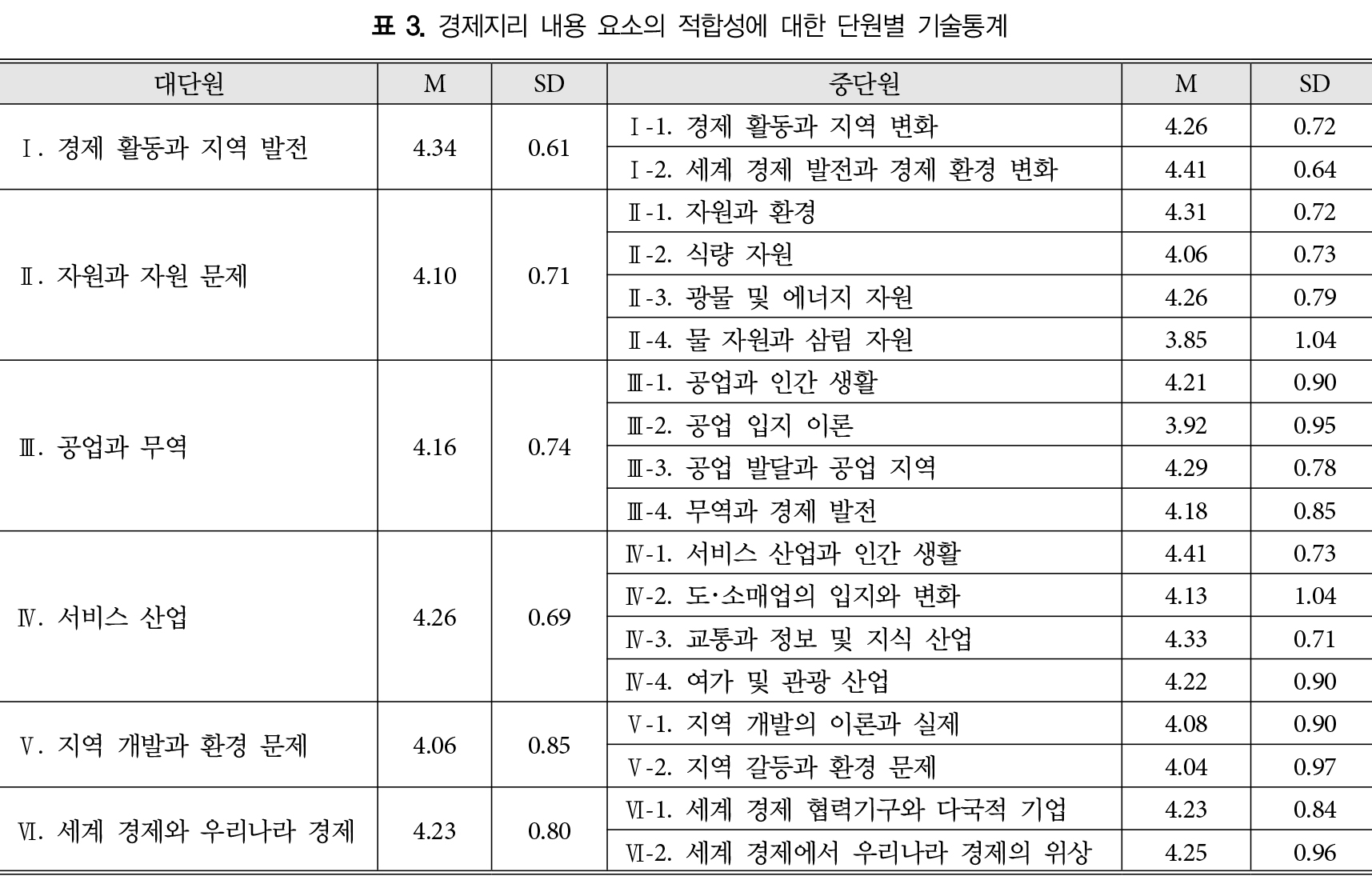
- The purpose of this study is to explore the possibility of reintroducing the subject of economic geography in the next national curriculum by analyzing the appropriateness of the content elements of economic geography and geography teachers’ perceptions of the subject’s educational value and feasibility of implementation in schools. To this end, based on the economic geography subject in the seventh national curriculum and the geography elective subjects in the 2022 revised national curriculum, 62 content elements and 8 items assessing perceptions of the subject were developed, and an online survey was conducted with 118 geography teachers nationwide. The collected data were analyzed using descriptive statistics, independent-samples t-tests, one-way ANOVA, and paired-samples t-tests, while qualitative analysis was conducted on the open-ended responses. The results showed that the overall appropriateness of the economic geography content elements was rated highly, with a mean score of 4.19. Content elements addressing the relationship between contemporary economic activities and regional change, such as spatial inequality, glocal value chains, transnational corporations, energy transition, food security, and commodity chains, were rated highly. In contrast, classical location theories, traditional trade theories, and basic descriptions of the distribution and characteristics of resources received relatively low ratings. Teachers’ perceptions of the economic geography subject were generally positive, but the perceived likelihood of students choosing the subject was relatively low compared with its perceived educational necessity. These findings suggest that reintroducing economic geography requires content centered on changes in contemporary economic space and real-world issues, stronger links to career pathways, and clearer differentiation from existing geography subjects.
- COLLAPSE
본 연구의 목적은 차기 교육과정에서 경제지리 과목의 재도입 가능성을 탐색하기 위해 경제지리 내용 요소의 적합성과 과목의 교육적 가치 및 현장 실행 가능성에 대한 지리교사의 인식을 분석하는 데 있다. 이를 위해 7차 교육과정의 경제지리와 2022 개정 교육과정의 지리 선택과목을 바탕으로 62개의 내용 요소와 8개의 과목 인식 문항을 구성하고, 전국의 지리 교사 118명을 대상으로 온라인 설문조사를 실시하였다. 수집된 자료는 기술통계, 독립표본 t검정, 일원배치 분산분석 및 대응표본 t검정을 통해 분석하였으며, 서술형 응답에 대해서는 질적 분석을 실시하였다. 연구 결과, 경제지리 내용 요소의 전체 적합도는 평균 4.19점으로 높게 나타났다. 공간적 불균등, 글로컬 가치사슬, 초국적 기업, 에너지 전환, 식량 안보 및 상품사슬 등 현대 경제활동과 지역 변화의 관계를 다룬 내용은 높게 평가된 반면, 고전 입지 이론, 전통 무역 이론 및 자원의 단순 분포와 특성은 상대적으로 낮게 평가되었다. 경제지리 과목에 대한 교사의 인식은 전반적으로 긍정적이었으나, 교육 필요성에 비해 학생 선택 가능성은 상대적으로 낮았다. 이러한 결과는 차기 교육과정에서 경제지리 과목의 재도입을 위해 현대 경제 공간의 변화와 실생활 문제를 중심으로 내용을 구성하고, 진로 연계와 기존 지리 과목과의 차별성을 강화할 필요가 있음을 시사한다.
-
An Analysis of Geography Teachers’ Perceptions of Economic Geography as a School Subject
-
Research Article
-
Development of a Metaverse-Based Place-Comparison Model for Teaching and Learning Cultural Diversity in Geography
지리교육에서의 문화 다양성 학습을 위한 메타버스 장소 비교 모형 개발
-
Jinhee Lee
이진희
- This study developed a metaverse-based model for teaching and learning cultural diversity in geography. The model guides students to investigate cultural issues …
본 연구는 문화 다양성 쟁점을 장소와 공간 이용의 맥락에서 탐구하여 수용적 판단으로 연결하는 메타버스 기반 지리 교수학습 모형을 개발하는 데 목적이 있다. …
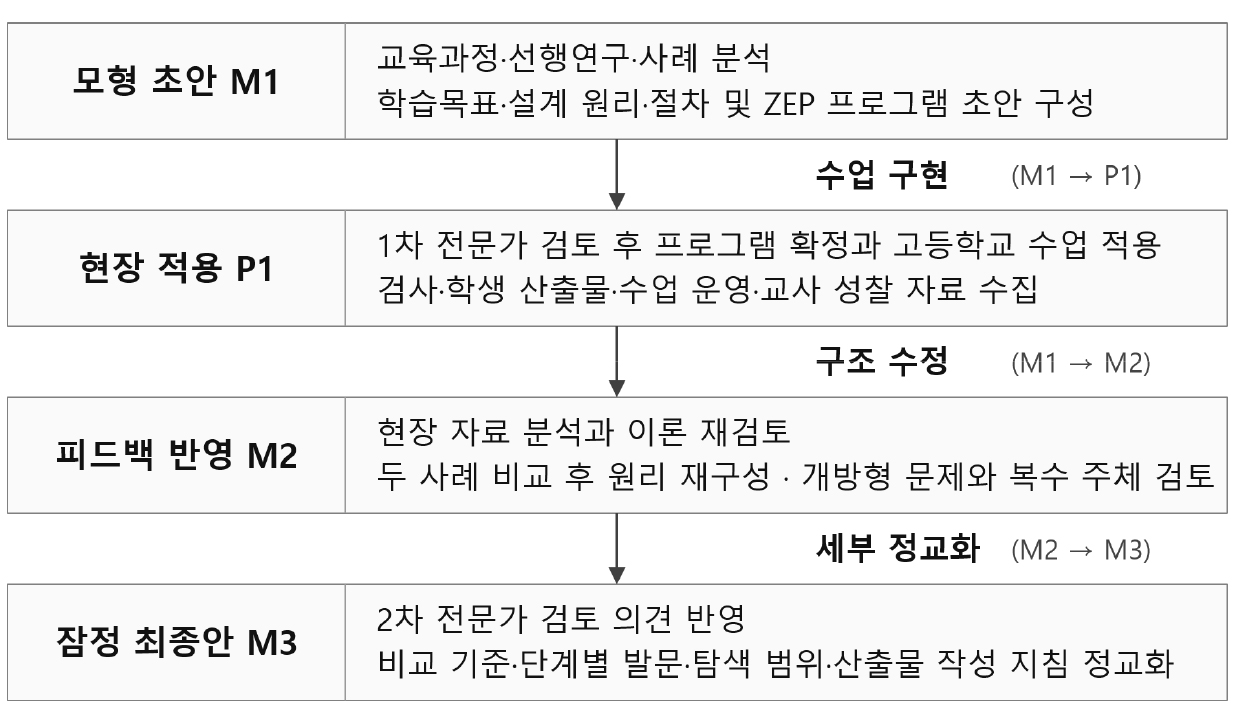
- This study developed a metaverse-based model for teaching and learning cultural diversity in geography. The model guides students to investigate cultural issues by examining places and how space is used, and to develop reasoned proposals that consider multiple stakeholders’ rights and interests. An initial model was developed through analyses of curriculum documents, previous research, and case materials. An initial expert review, a ZEP-based lesson implemented with tenth-grade students for formative evaluation, and a re-examination of relevant theories informed revisions to the learning sequence, representations of places, and learning tasks. The revised model underwent a second expert review, and the feedback informed further refinements. The resulting provisional model comprises seven stages: identifying the problem; exploring Case A and developing an initial explanation of relationships among people and places; exploring Case B; comparing the cases using common criteria; revising explanations and reformulating principles of coexistence; evaluating options for reconciling stakeholders’ rights and interests; and presenting proposed solutions and reflecting on their limitations.
- COLLAPSE
본 연구는 문화 다양성 쟁점을 장소와 공간 이용의 맥락에서 탐구하여 수용적 판단으로 연결하는 메타버스 기반 지리 교수학습 모형을 개발하는 데 목적이 있다. 교육과정·선행연구·사례 자료를 분석해 모형 초안을 구성하였다. 이어 1차 전문가 검토와 고등학교 1학년 대상 ZEP 수업에서 확인된 문제 및 관련 이론의 재검토를 바탕으로 단계 배열, 사례 재현과 과제 구성을 수정하였다. 수정 모형에 대한 2차 전문가 검토 의견을 반영하여 비교 기준과 단계별 발문을 정교화하였다. 그 결과 ‘문제 진입-사례 A 탐색과 잠정적 관계 설명-사례 B 탐색-공통 기준에 따른 장소 비교-관계 설명과 공존 원리의 재구성-이해관계별 조정안 검토-표현과 성찰’의 일곱 단계로 이루어진 잠정 모형을 제안하였다.
-
Development of a Metaverse-Based Place-Comparison Model for Teaching and Learning Cultural Diversity in Geography
-
Research Article
-
Reinterpreting Children’s Citizenship through Lefebvre’s Socio-Spatial Theory
르페브르 사회공간론에 기반한 어린이 시민성의 재해석
-
Yunha Kim
김윤하
- 본 연구는 어린이 시민성을 권리, 의무, 참여, 정체성 중심으로 이해해 온 기존 논의를 르페브르의 사회공간론적 관점에서 재해석하는 데 목적이 있다. 기존 어린이 …
This study aims to reinterpret existing discussions of children’s citizenship—traditionally understood in terms of rights, responsibilities, participation, and identity—from the perspective of …
- 본 연구는 어린이 시민성을 권리, 의무, 참여, 정체성 중심으로 이해해 온 기존 논의를 르페브르의 사회공간론적 관점에서 재해석하는 데 목적이 있다. 기존 어린이 시민성 연구는 어린이를 현재의 삶 속에서 사고하고 판단하는 시민적 주체로 이해하고, 어린이의 장소 경험과 시민성의 관계를 탐색해 왔다. 이를 르페브르의 사회공간론을 통해 공간 질서와 어린이의 몸과 감각, 관계와 실천의 관계로 확장하여 살펴보았다. 이에 본 연구는 르페브르의 공간생산론과 차이 공간 개념을 바탕으로 어린이 시민성을 공간 안에서 발현되는 자질이 아니라, 공간의 의미와 질서를 지각하고 해석하며 변형하는 실천으로 재해석하였다. 어린이 시민성, 어린이 일상생활 공간, 르페브르 사회공간론 관련 문헌을 이론적·해석적으로 검토하였고, 연구 결과, 어린이 시민성은 공간 맥락을 몸으로 읽어내는 ‘깨어나는 지각’, 주어진 공간의 의미를 의심하고 비트는 ‘창조적 인지’, 공간을 전유하며 다른 질서를 만들어 가는 ‘활동가적 시민성’으로 재구성될 수 있었다. 어린이 시민성교육은 제도화된 참여 프로그램의 제공을 넘어, 어린이가 자신의 일상생활 공간을 감각하고 해석하며 변형할 수 있는 경험을 열어 주는 방향으로 확장될 필요가 있다.
- COLLAPSE
This study aims to reinterpret existing discussions of children’s citizenship—traditionally understood in terms of rights, responsibilities, participation, and identity—from the perspective of Lefebvre’s theory of social space. Previous studies of children’s citizenship have recognized children as civic subjects who think and make judgments within their present lives and have explored the relationship between children’s experiences of place and citizenship. Drawing on Lefebvre’s theory of social space, this study extends such discussions by examining the relationships among spatial order, children’s bodies and senses, social relations, and practices. Based on Lefebvre’s theory of the production of space and the concept of differential space, this study reconceptualizes children’s citizenship not as a set of qualities manifested within space, but as a practice through which children perceive, interpret, and transform the meanings and orders of space. Literature on children’s citizenship, children’s everyday spaces, and Lefebvre’s theory of social space was reviewed theoretically and interpretively. The findings suggest that children’s citizenship can be reconstructed in three dimensions: “awakened perception,” through which children bodily perceive and read spatial contexts; “creative cognition,” through which they question and disrupt the given meanings of space; and “activist citizenship,” through which they appropriate space and create alternative spatial orders. Accordingly, citizenship education for children needs to move beyond the provision of institutionalized participation programs and expand toward creating opportunities for children to sense, interpret, and transform the spaces of their everyday lives.
-
Reinterpreting Children’s Citizenship through Lefebvre’s Socio-Spatial Theory
-
Research Article
-
Peace and Unification Education in Geography under the 2022 Revised National Curriculum: A Semantic Network Analysis of the Curriculum and Textbooks
2022 개정 교육과정 지리 교과의 평화·통일교육: 교육과정과 교과서의 언어네트워크 분석을 중심으로
-
Hyejin Kim ⋅ Chul-Ki Cho ⋅ Yunmi Lee
김혜진 · 조철기 · 이윤미
- This study employed semantic network analysis to examine the curriculum and textbooks for peace and unification education in geography under the 2022 …
본 연구는 2022 개정 교육과정에 따른 지리 교과 평화·통일교육의 교육과정과 교과서를 언어네트워크 분석을 하였다. 분석 결과, 첫째, 교육과정 성취기준에서는 ‘당위적 통일’에서 ‘공간적 …
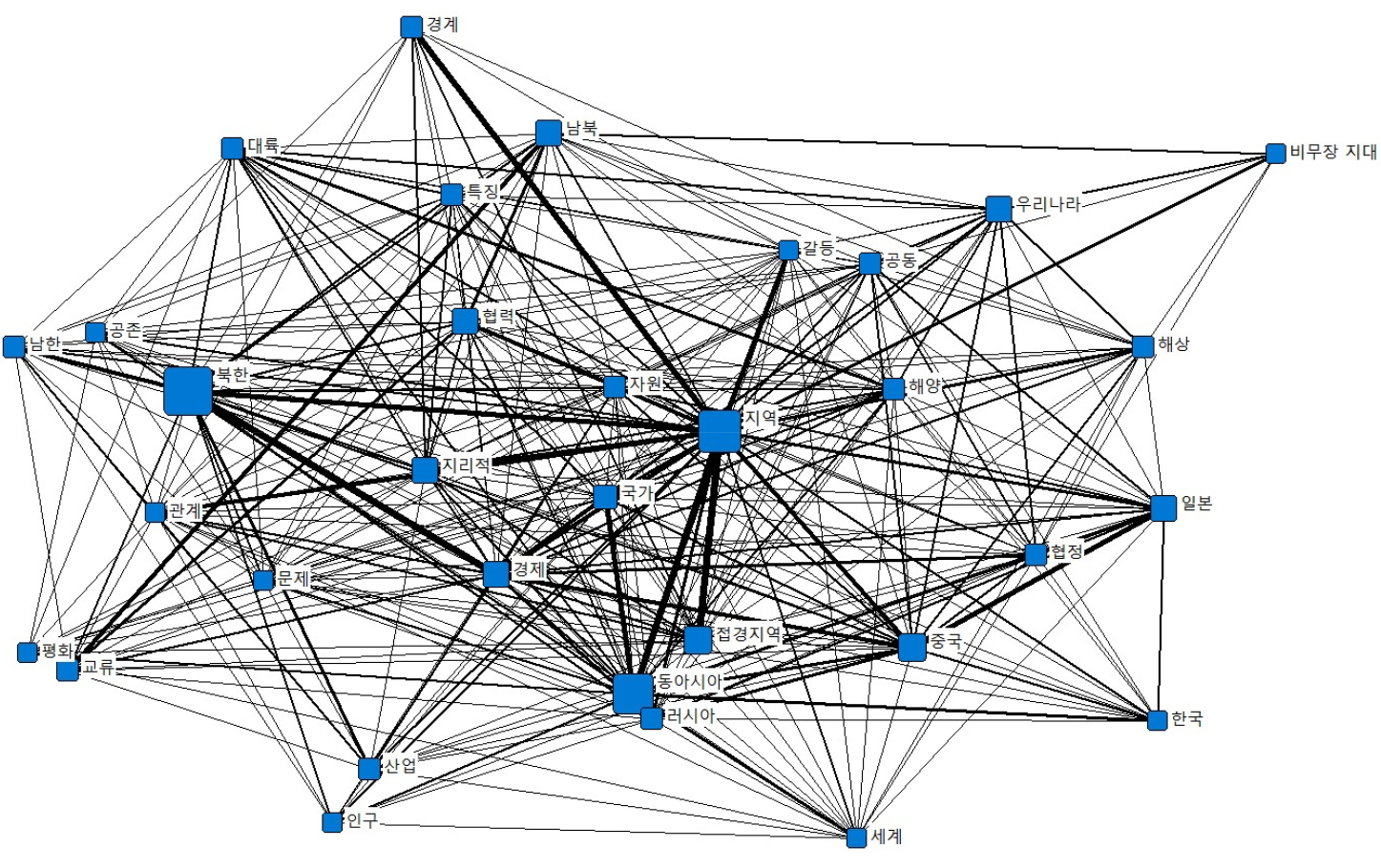
- This study employed semantic network analysis to examine the curriculum and textbooks for peace and unification education in geography under the 2022 Revised National Curriculum. The findings are as follows. First, the achievement standards revealed a shift from “normative unification” toward “spatial peace.” Second, spatial and geographical concepts such as “border area,” “Korean Peninsula,” “region,” and “geopolitical” occupied structurally central positions in the network, highlighting the distinctive characteristics of geography as a school subject. Third, both continuity and differentiation across school levels were identified in terms of spatial scope and relational context. This study is significant in that it applies semantic network analysis to geography-based peace and unification education, identifies the semantic structure of peace and unification education in the 2022 Revised National Curriculum, and provides a foundation for the future development of peace and unification education.
- COLLAPSE
본 연구는 2022 개정 교육과정에 따른 지리 교과 평화·통일교육의 교육과정과 교과서를 언어네트워크 분석을 하였다. 분석 결과, 첫째, 교육과정 성취기준에서는 ‘당위적 통일’에서 ‘공간적 평화’로의 전환이 나타났다. 둘째, ‘접경지역’, ‘한반도’, ‘지역’, ‘지정학적’ 등 공간적·지리적 개념이 네트워크의 구조적 중심을 차지함으로써 지리 교과의 차별적 특성이 확인되었다. 셋째, 학교급 간 공간적 범위와 관계적 맥락의 측면에서 계열성과 차별성이 확인되었다. 본 연구는 지리 기반 평화·통일교육 연구에 언어 네트워크 분석을 적용하여 2022 개정 교육과정의 의미 구조를 확인하고, 향후 평화·통일교육을 위한 기초 자료를 제공하였다는 점에서 의의를 가진다.
-
Peace and Unification Education in Geography under the 2022 Revised National Curriculum: A Semantic Network Analysis of the Curriculum and Textbooks
-
Research Article
-
Reconstructing Cultural Landscape Conservation Strategies through the Novel Ecosystem Concept: A Comparative Analysis of World Heritage Cases
신생태계 개념을 통한 문화경관 보존 전략의 재구성: 세계유산 사례 분석을 중심으로
-
Eojin Jeong ⋅ Sook-Jin Kim
정어진 · 김숙진
- This study examines structural limitations in the conservation and management of UNESCO World Heritage cultural landscapes and explores the applicability of the …
본 연구는 유네스코 세계유산 문화경관 보존·관리의 구조적 한계를 진단하고, 신생태계(novel ecosystems) 관점의 적용 가능성을 검토하였다. 세계유산 제도는 등재 시점의 가치를 고정된 기준으로 …
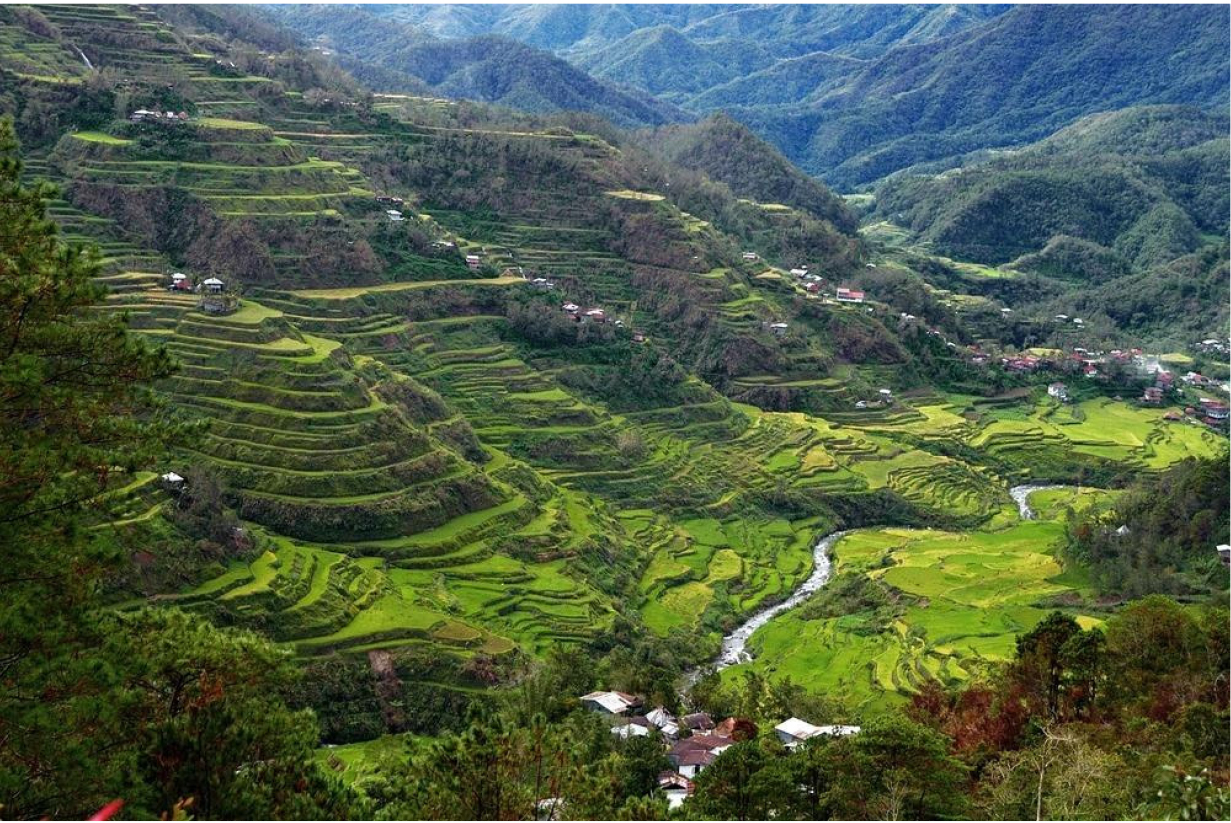
- This study examines structural limitations in the conservation and management of UNESCO World Heritage cultural landscapes and explores the applicability of the ecological concept of novel ecosystems as a complementary interpretive framework. Although cultural landscapes are dynamic heritages formed through continuous interaction between humans and nature, the World Heritage system treats the Outstanding Universal Value (OUV) established at inscription as a fixed reference, treating subsequent change as damage. This reveals three structural limitations: a static conservation paradigm, a materially fixed conception of authenticity, and the structural exclusion of local communities. This study analyzes two cases at opposite ends of institutional responses to change—the Dresden Elbe Valley (delisted) and the Rice Terraces of the Philippine Cordilleras (removed from the danger list)—through a two-stage analytical framework, first diagnosing structural limitations and then reinterpreting each case through the novel ecosystem framework. Despite differing conditions, both cases converged on the same structural contradictions, indicating that the crisis observed in these two cases lies not in conservation technique but in the structural absence of negotiated governance through community participation.
- COLLAPSE
본 연구는 유네스코 세계유산 문화경관 보존·관리의 구조적 한계를 진단하고, 신생태계(novel ecosystems) 관점의 적용 가능성을 검토하였다. 세계유산 제도는 등재 시점의 가치를 고정된 기준으로 삼아 이후 변화를 훼손으로 단정하는 정태적 보존 패러다임, 진정성 개념의 물질적 고착, 지역공동체의 구조적 배제라는 한계를 안고 있다. 이에 드레스덴 엘베 계곡(등재 말소)과 필리핀 코르디예라 벼농사 경관(위험목록 해제)의 구조적 한계를 진단하고 신생태계 관점에서 재해석·비교하였다. 분석 결과 두 사례는 상이한 조건에도 동일한 구조적 모순으로 수렴하였으며, 이러한 공통된 문제의 근원이 공동체 참여를 통한 협상적 거버넌스의 부재에 있음을 확인하였다. 이를 토대로 SOUV 재검토 절차 제도화, 진정성 평가 기준 마련, 완전성 조건 개정을 제언한다.
-
Reconstructing Cultural Landscape Conservation Strategies through the Novel Ecosystem Concept: A Comparative Analysis of World Heritage Cases
-
Research Article
-
Changes in the Spatial Patterns of Depressive Symptoms before, during, and after the COVID-19 Pandemic in Korea: Evidence from Spatial Panel Models and Multiscale Geographically Weighted Regression
코로나19 전후 우울감의 공간 분포 변화: 공간패널모형과 다중 스케일 지리가중회귀의 적용
-
Jaeeun Lee ⋅ Changmin Im ⋅ Youngho Kim
이재은 · 임창민 · 김영호
- This study examined changes in the nationwide spatial patterns of depressive symptoms across the COVID-19 pandemic in Korea. Hotspots of depressive symptoms …
본 연구는 우울감경험률의 전국 단위 공간 분포가 코로나19를 거치며 어떻게 달라졌는지 분석하였다. 우울감의 핫스팟은 코로나 시기에 줄었다. 이웃 지역의 우울감만 고려한 공간시차모형에서 …
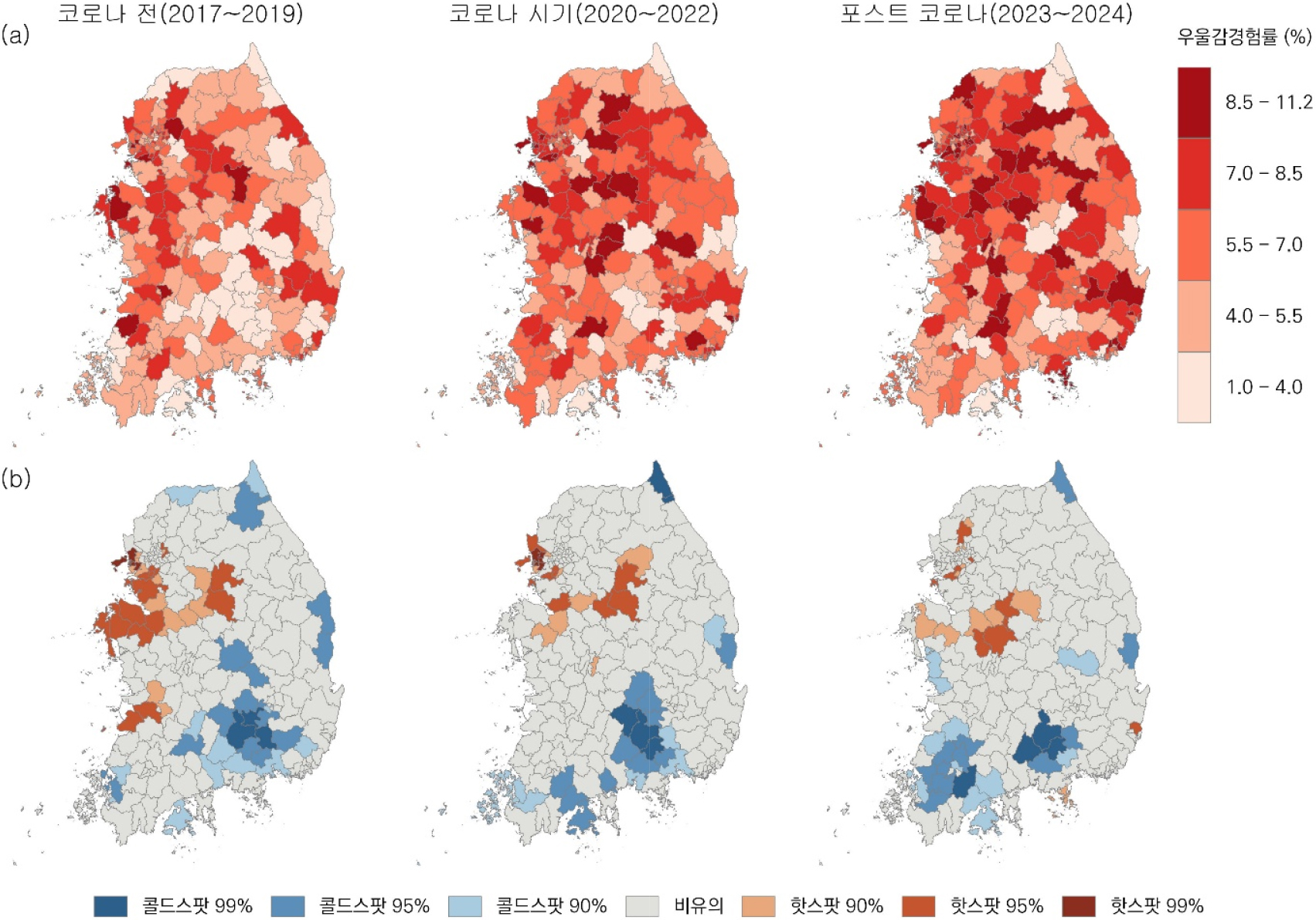
- This study examined changes in the nationwide spatial patterns of depressive symptoms across the COVID-19 pandemic in Korea. Hotspots of depressive symptoms decreased during the pandemic. In the spatial lag model, the association between neighboring and local depressive symptoms was not significant during social distancing and re-emerged in 2023 and 2024. Once the spatial Durbin model controlled for the six covariates of neighboring districts, the association appeared only weakly before the pandemic and was sensitive to model specification. The annual unmet healthcare need rate showed the strongest association with depressive symptoms in all three periods. From the pandemic onward, walking, volunteering, high-risk drinking, and out-migration in neighboring districts were associated with local depressive symptoms. Residents’ activities and mobility therefore gained weight relative to neighboring depressive symptoms in the spatial association. In the multiscale geographically weighted regression, the association between walking practice and depressive symptoms was significant only in some districts before the pandemic but in all districts from the pandemic onward. The findings indicate the need for mental health policy to consider both district units and activity areas.
- COLLAPSE
본 연구는 우울감경험률의 전국 단위 공간 분포가 코로나19를 거치며 어떻게 달라졌는지 분석하였다. 우울감의 핫스팟은 코로나 시기에 줄었다. 이웃 지역의 우울감만 고려한 공간시차모형에서 인접 지역 간 연관은 거리두기 기간에 유의하지 않았다가 일상이 회복된 2023~2024년에 다시 유의해졌다. 이웃 지역의 건강, 의료, 사회, 인구 요인을 통제한 공간더빈모형에서는 우울감의 지역 간 연관이 코로나 전에만 약하게 나타났으며, 모형 설정에 민감하였다. 연간 미충족 의료율은 세 시기 모두 우울감과 가장 강하게 연관되었다. 코로나19 이후에는 이웃 지역의 활동(걷기, 자원봉사, 고위험 음주, 전출 등)이 자기 지역의 우울감과 연관되었다. 우울감의 지역 간 연관에서 이웃 지역의 우울감보다 주민의 활동과 이동이 차지하는 비중이 커진 것이다. 다중 스케일 지리가중회귀에서 걷기 실천율과 우울감의 연관은 코로나 전에는 일부 지역에서만 유의하였으나, 코로나19 이후에는 전국에서 유의하였다. 본 연구의 결과는 정신건강 정책에서 시군구 단위와 생활권 단위의 접근을 함께 검토할 필요가 있음을 보여준다.
-
Changes in the Spatial Patterns of Depressive Symptoms before, during, and after the COVID-19 Pandemic in Korea: Evidence from Spatial Panel Models and Multiscale Geographically Weighted Regression
-
Research Article
-
An International Comparison of Fertility and Mortality Methods for Subnational Population Projections
국가 내 지역 인구추계를 위한 출산력 및 사망력 설정 방법의 국제 비교
-
Sang-Il Lee ⋅ Hyeongmo Koo ⋅ Soyoung Lee ⋅ Daeheon Cho
이상일 · 구형모 · 이소영 · 조대헌
- This study compares how fertility and mortality components are specified in official subnational population projections in eight countries—the United States, Canada, Brazil, …
본 연구는 미국, 캐나다, 브라질, 영국(잉글랜드), 노르웨이, 덴마크, 오스트레일리아, 일본의 공식 지역 인구추계에서 출산력과 사망력 컴포넌트가 어떻게 설정되는지를 비교하고, 이를 바탕으로 한국의 …
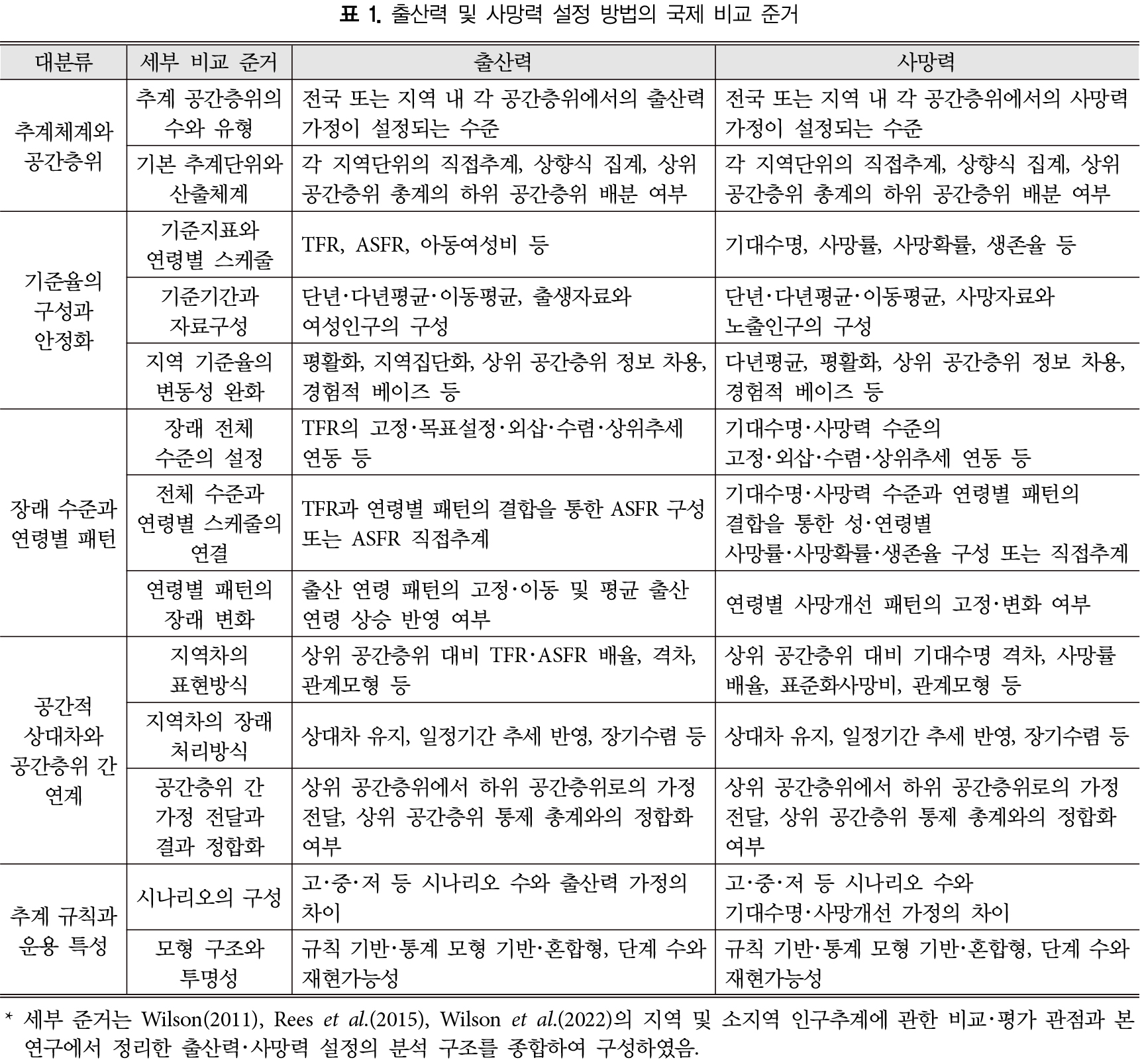
- This study compares how fertility and mortality components are specified in official subnational population projections in eight countries—the United States, Canada, Brazil, the United Kingdom (England), Norway, Denmark, Australia, and Japan—and draws implications for provincial and municipal projections in Korea. The comparison focuses on baseline-rate stabilization, future overall levels and age patterns, regional differentials, linkages and reconciliation across spatial hierarchies, and scenario design. Three findings emerge. First, many countries combine future trajectories specified at the national or higher spatial level with regional differentials rather than independently forecasting age-specific rates for each area over the long term. Second, statistical refinement is used mainly to reduce instability in baseline rates caused by small numbers and to estimate relative regional positions, using methods such as multi-year averaging, smoothing, borrowing information from higher spatial levels, and empirical Bayes estimation. Third, spatial hierarchy functions as a key methodological device for stabilizing baseline rates, transmitting future assumptions, and reconciling projections across spatial levels. For Korea, the findings suggest distinguishing the roles of statistical models and demographic assumptions: national projections would set long-term trajectories and scenarios, regional projections would serve as intermediate reference units for regional levels and age patterns, and local projections would focus on estimating stabilized relative differentials and short-term local characteristics. Such alternatives should be compared with existing models through backtesting in terms of accuracy, stability, interpretability, and maintainability, and adopted selectively when they show sustained improvement.
- COLLAPSE
본 연구는 미국, 캐나다, 브라질, 영국(잉글랜드), 노르웨이, 덴마크, 오스트레일리아, 일본의 공식 지역 인구추계에서 출산력과 사망력 컴포넌트가 어떻게 설정되는지를 비교하고, 이를 바탕으로 한국의 시도 및 시군구 추계 방법의 개선 방향을 제시하였다. 비교는 기준율의 안정화, 장래의 전체 수준과 연령별 패턴, 지역의 상대적 차이, 공간층위 간 연계와 정합화, 장래 시나리오를 중심으로 이루어졌다. 분석 결과, 첫째, 여러 국가에서는 각 지역의 연령별 비율을 독립적으로 장기 예측하기보다 전국 또는 상위 공간층위에서 설정한 장래 경로와 지역의 상대차를 결합한다. 둘째, 통계적 정교화는 작은 수에 따른 기준율의 불안정성을 완화하고 지역의 상대적 위치를 추정하는 데 주로 활용되며, 다년 평균, 평활화, 상위 공간층위의 정보 차용, 경험적 베이즈 등의 방법이 사용된다. 셋째, 공간층위는 기준율의 안정화, 장래 가정의 전달, 공간층위 간 정합화를 위한 핵심적인 방법론적 장치로 기능한다. 이에 따라 한국에서도 통계 모형과 인구학적 장래 가정의 역할을 구분하고, 전국은 장기 경로와 시나리오, 시도는 중간 준거와 지역별 수준 및 연령 패턴, 시군구는 안정화된 상대차와 단기적 지역 특성의 추정에 집중하는 체계를 검토할 필요가 있다. 이러한 대안은 현행 모형과의 사후 검증을 통해 정확성, 안정성, 설명 가능성 및 유지 관리성을 비교한 뒤 선택적으로 도입하는 것이 바람직하다.
-
An International Comparison of Fertility and Mortality Methods for Subnational Population Projections
-
Research Article
-
Land Cover–Temperature Relationships Across Quantiles of Summer Daily Maximum Temperature in Seoul
서울시의 여름철 분위별 일 최고기온과 토지피복과의 관계
-
Yoonjin Ro
노윤진
- This study examines how conditional relationships between urban land cover types and summer daily maximum temperature vary across temperature quantiles in Seoul. …
본 연구는 서울시를 대상으로 여름철 일 최고기온 분포의 분위별 조건에서 토지피복 유형과 기온 간의 조건부 관련성이 어떠한 양상으로 나타나는지를 분석하였다. 2023~2025년 S-DoT(Smart …
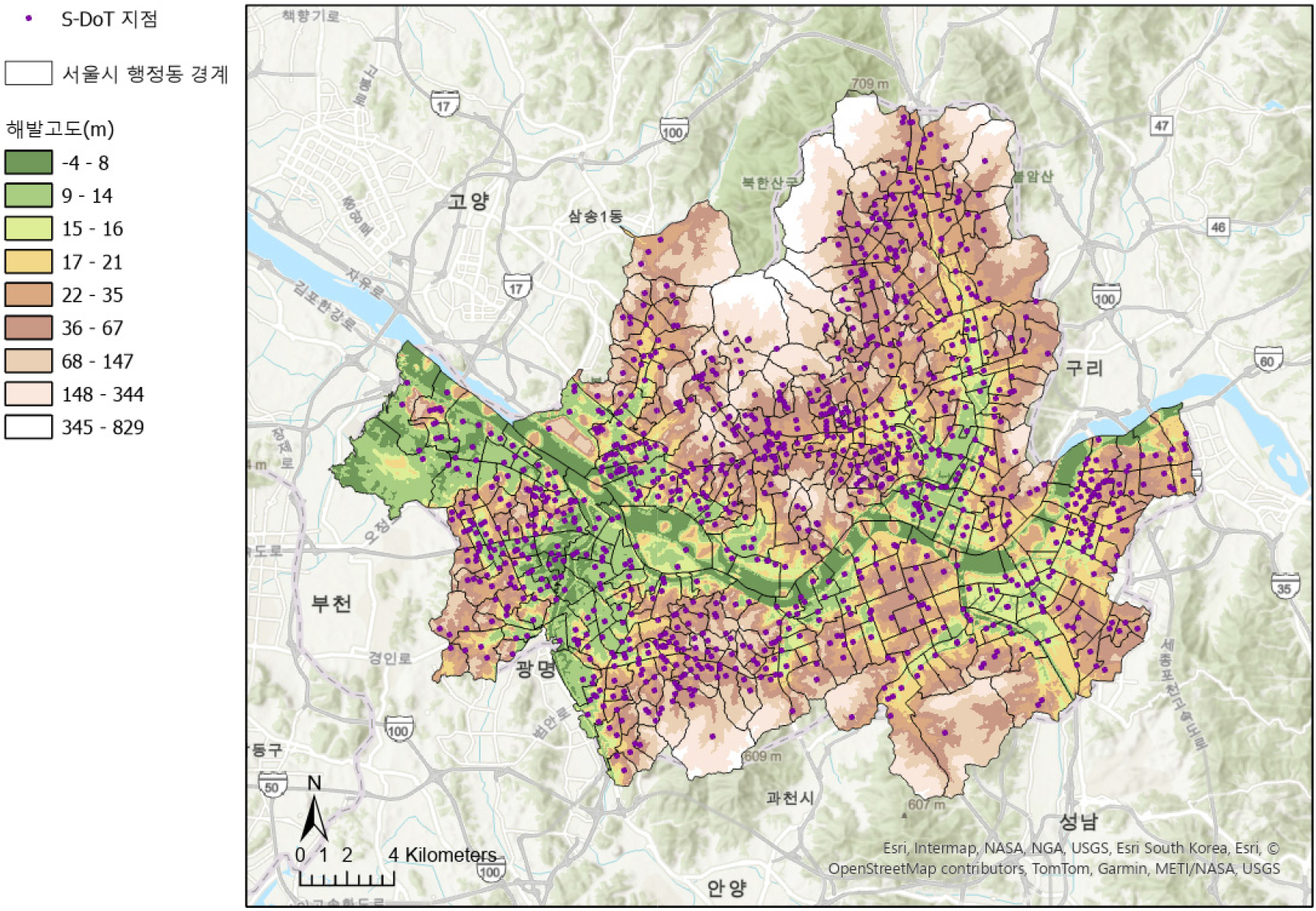
- This study examines how conditional relationships between urban land cover types and summer daily maximum temperature vary across temperature quantiles in Seoul. Using three years (2023~2025) of S-DoT (Smart Seoul Data of Things) observations and land cover proportions within 200m buffers around monitoring sites, multivariable quantile regression models were estimated for the 50th, 75th, 90th, and 95th quantiles. Impervious surfaces were significantly and positively associated with daily maximum temperature across all quantiles, with coefficient estimates somewhat larger at the 90th and 95th quantiles than at the 50th and 75th quantiles. Tree cover was significantly and negatively associated across all quantiles, although the absolute magnitude of the coefficient estimates was smaller at the upper quantiles. Water areas showed negative associations across all quantiles, but none were statistically significant, while grass showed significant positive associations across all quantiles. These findings suggest that urban heat management should consider not only average temperature conditions, but also how associations between land cover types and daily maximum temperature differ across quantiles of summer daily maximum temperature.
- COLLAPSE
본 연구는 서울시를 대상으로 여름철 일 최고기온 분포의 분위별 조건에서 토지피복 유형과 기온 간의 조건부 관련성이 어떠한 양상으로 나타나는지를 분석하였다. 2023~2025년 S-DoT(Smart Seoul Data of Things) 관측자료와 각 관측지점 주변 200m 버퍼 내 토지피복 비율을 결합하고, 일 최고기온 분포의 50%, 75%, 90%, 95% 분위에 대한 분위 회귀분석을 수행하였다. 분석 결과, 불투수면은 모든 분위에서 일 최고기온과 유의한 양(+)의 관련성을 나타냈으며 계수 점추정치는 50%와 75% 분위보다 90%와 95% 분위에서 다소 크게 나타났다. 수목은 모든 분위에서 유의한 음(-)의 관련성을 나타냈으며, 계수 점추정치의 절댓값은 상위 분위에서 작게 나타났다. 수계는 전 분위 음(-)의 관련성을 보였으나 통계적 유의성은 확인되지 않았고, 초지는 전 분위에서 유의한 양(+)의 관련성을 나타냈다. 이러한 결과는 도시 열환경 관리에서 평균적인 기온 조건뿐만 아니라 일 최고기온 분포의 분위에 따라 도시의 다양한 토지피복과 기온 간의 관련성이 상이하게 나타날 수 있음을 함께 고려할 필요성을 시사한다.
-
Land Cover–Temperature Relationships Across Quantiles of Summer Daily Maximum Temperature in Seoul
-
Research Article
-
Exploring the Spatial Patterns of Closed Schools by Regional Types in South Korea
지역 특성에 따른 폐교의 공간 패턴 탐색
-
Jungyeop Shin ⋅ Asoo Choi
신정엽 · 최아수
- This study empirically examines the distribution and patterns of school closures in South Korea in relation to regional characteristics. While prior studies …
본 연구는 지역 특성 측면에서 국내 폐교 분포와 패턴을 실증적으로 탐색하는 목적을 가진다. 그동안 폐교 연구는 주로 교육, 정책 관점에 초점을 둔 …
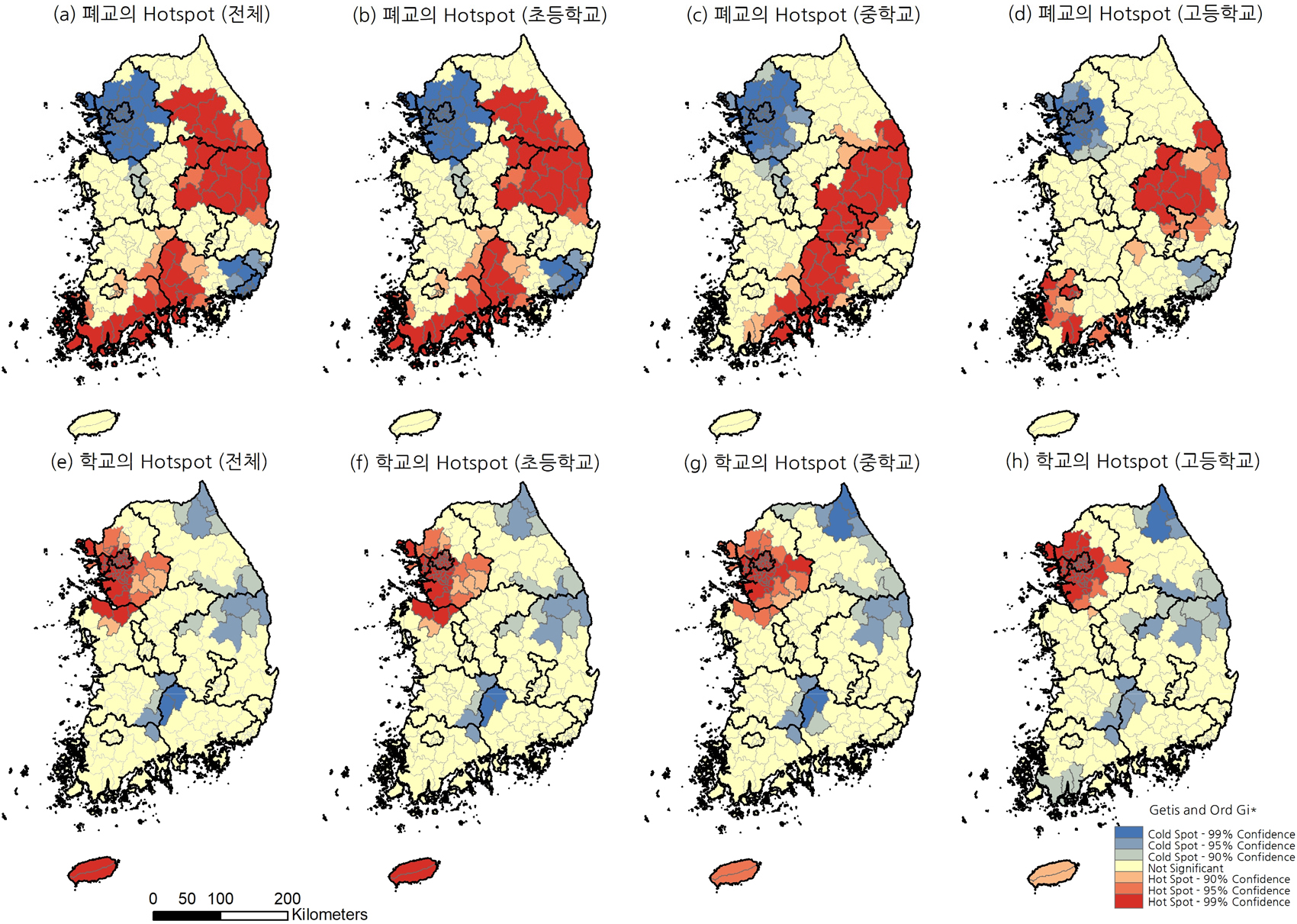
- This study empirically examines the distribution and patterns of school closures in South Korea in relation to regional characteristics. While prior studies on school closures have primarily focused on educational and policy perspectives, empirical research focusing on regional characteristics from a geographical perspective remains limited. This study investigates the geographical distribution and patterns of closed schools across South Korea and, on this basis, explores their spatial patterns in relation to regional characteristics. The findings indicate that elementary schools accounted for an overwhelmingly large proportion of school closures and that closures have continued since they began in earnest during the 1990s. Spatially, school closures tended to be concentrated in rural areas and small cities rather than in large metropolitan areas. Hotspots were also identified primarily in the Jeollanam-do, Gyeongsangnam-do, Gyeongsangbuk-do, and Gangwon-do regions, contrasting with the hotspot pattern of currently operating schools in Korea. Finally, multiple linear regression analyses were conducted for the full sample and by regional type to examine associations with factors related to school closures. The significance of these factors differed across regional types, underscoring the need for in-depth consideration of diverse regional characteristics rather than a uniform educational approach. In addition, spatial regression analysis accounting for spatial autocorrelation improved model fit, thereby confirming the spatial nature of factors associated with school closures.
- COLLAPSE
본 연구는 지역 특성 측면에서 국내 폐교 분포와 패턴을 실증적으로 탐색하는 목적을 가진다. 그동안 폐교 연구는 주로 교육, 정책 관점에 초점을 둔 반면, 지리적 관점에서 지역 특성을 고려하여 분석한 폐교의 실증적 연구는 부족하였다. 이에 본 연구는 국내 폐교를 대상으로 지리적 분포와 패턴을 탐색하였으며, 이를 토대로 지역 특성을 고려한 폐교의 공간 패턴을 탐색하였다. 분석 결과, 폐교는 학교급 측면에서 초등학교 비중이 압도적으로 컸으며, 시기 측면에서도 1990년대 폐교가 본격 진행된 이후 현재까지 지속됨을 확인하였다. 공간분포 측면에서, 폐교는 대도시보다 농촌, 소규모 도시에 집중된 경향이 있었으며, 또한 전남-경남-경북-강원을 중심으로 한 지역에서 핫스팟이 탐색되었는데, 이는 현재 학교의 핫스팟 패턴과 대조를 보였다. 마지막으로 폐교 관련 요인에 대한 연관성 탐색을 위해 다중회귀분석을 전체, 지역 유형별로 수행하였다. 지역 유형에 따라 관련 요인의 유의성이 서로 다름을 확인하였는데, 이를 토대로 획일화된 교육적 접근보다는 다양한 지역 특성의 심층적인 검토 필요성을 확인하였다. 또한 공간 자기상관성을 고려한 공간회귀분석을 적용한 결과 모형 적합도가 개선되었는데, 이를 통해 폐교 요인의 공간성을 확인할 수 있었다.
-
Exploring the Spatial Patterns of Closed Schools by Regional Types in South Korea
-
Research Article
-
Factors Related to Local Settlement Intention among Foreign Migrant Workers in Depopulation Regions: A Case Study of Yeongam, Nonsan, and Miryang
인구감소지역 외국인 이주노동자의 지역정착 의향과 관련 요인: 영암·논산·밀양을 사례로
-
Heeyoun You
유희연
- This study examined the residency conditions of migrant workers and their local residential stay intention, along with related factors, focusing on Yeongam-gun …
본 연구는 인구감소지역인 전남 영암군, 충남 논산시, 경남 밀양시를 사례로 외국인 이주노동자의 체류실태, 지역잔류 의향 및 관련요인을 분석하였다. 지역별 잔류의향률은 논산(69.8%), 밀양(65.2%), …
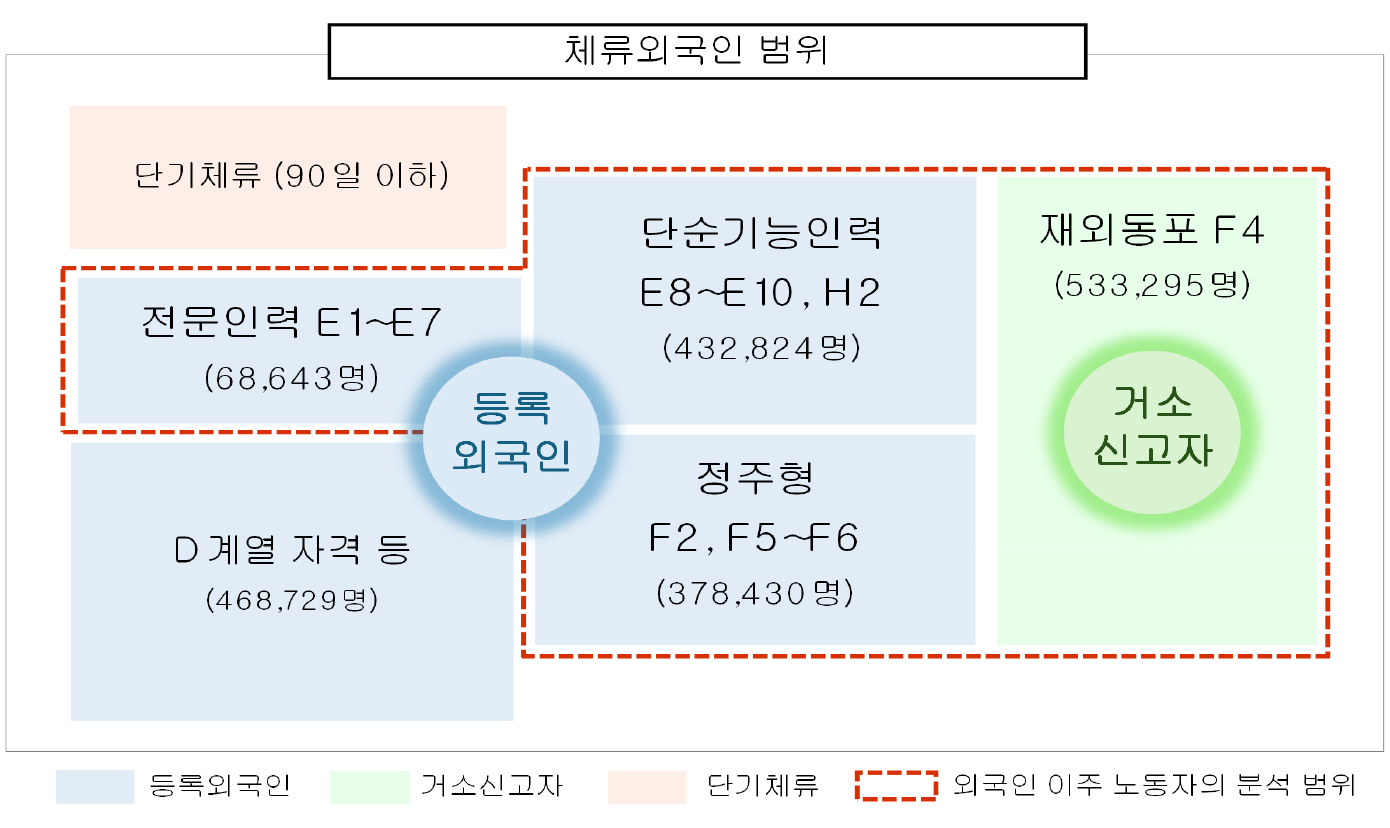
- This study examined the residency conditions of migrant workers and their local residential stay intention, along with related factors, focusing on Yeongam-gun (Jeollanam-do), Nonsan-si (Chungcheongnam-do), and Miryang-si (Gyeongsangnam-do)—depopulation regions in South Korea. Residential stay intention rates differed significantly by region, in the order of Nonsan (69.8%), Miryang (65.2%), and Yeongam (42.6%). Logistic regression analysis showed that sense of belonging to one's home country had a significant negative association with local residential stay intention, a finding that remained consistent across visa-status subsample analyses. By contrast, neighborhood social ties and life satisfaction were not significant in the full sample but showed significant positive associations in certain visa-status subsamples, suggesting that the factors related to residential stay intention may vary by visa status. These findings suggest that policy support for migrant workers' local settlement should move beyond a uniform approach centered on a single factor, toward differentiated strategies that jointly consider stable livelihood foundations and visa-status-based heterogeneity.
- COLLAPSE
본 연구는 인구감소지역인 전남 영암군, 충남 논산시, 경남 밀양시를 사례로 외국인 이주노동자의 체류실태, 지역잔류 의향 및 관련요인을 분석하였다. 지역별 잔류의향률은 논산(69.8%), 밀양(65.2%), 영암(42.6%) 순으로 유의한 차이를 보였다. 로지스틱 회귀분석 결과, 모국소속감은 지역 잔류의향과 유의한 부(-)의 관련성을 보였으며, 이는 체류자격별 하위표본 분석에서도 일관되게 나타났다. 반면 동네 관계망과 생활만족도는 전체 표본에서는 유의하지 않았으나 특정 체류자격 하위표본에서는 유의한 정(+)의 관련성을 나타내, 잔류의향 관련요인이 체류자격별 하위표본에 따라 다르게 나타날 가능성을 시사한다. 이는 외국인 이주노동자의 지역정착 지원정책이 단일 요인 중심의 획일적 접근에서 벗어나, 생활기반 안정과 체류자격별 이질성을 함께 고려한 차별화된 방식으로 추진될 필요가 있음을 시사한다.
-
Factors Related to Local Settlement Intention among Foreign Migrant Workers in Depopulation Regions: A Case Study of Yeongam, Nonsan, and Miryang
-
Research Article
-
Analyzing Consistency among Types of Mobile Network-Based Floating Population Data: A Case Study of Danyang-gun and Cheongsong-gun
통신사 유동인구 자료의 일관성 분석: 단양군과 청송군 사례
-
Yongha Park
박용하
- This study examines consistency among floating population datasets derived from the same underlying mobile network data using different aggregation criteria and identifies …
본 연구는 동일한 이동통신 원자료에서 집계 기준을 달리하여 산출된 유동인구 자료 간 일관성을 검토하고, 자료 활용 시 고려해야 할 사항을 제시하는 것을 …
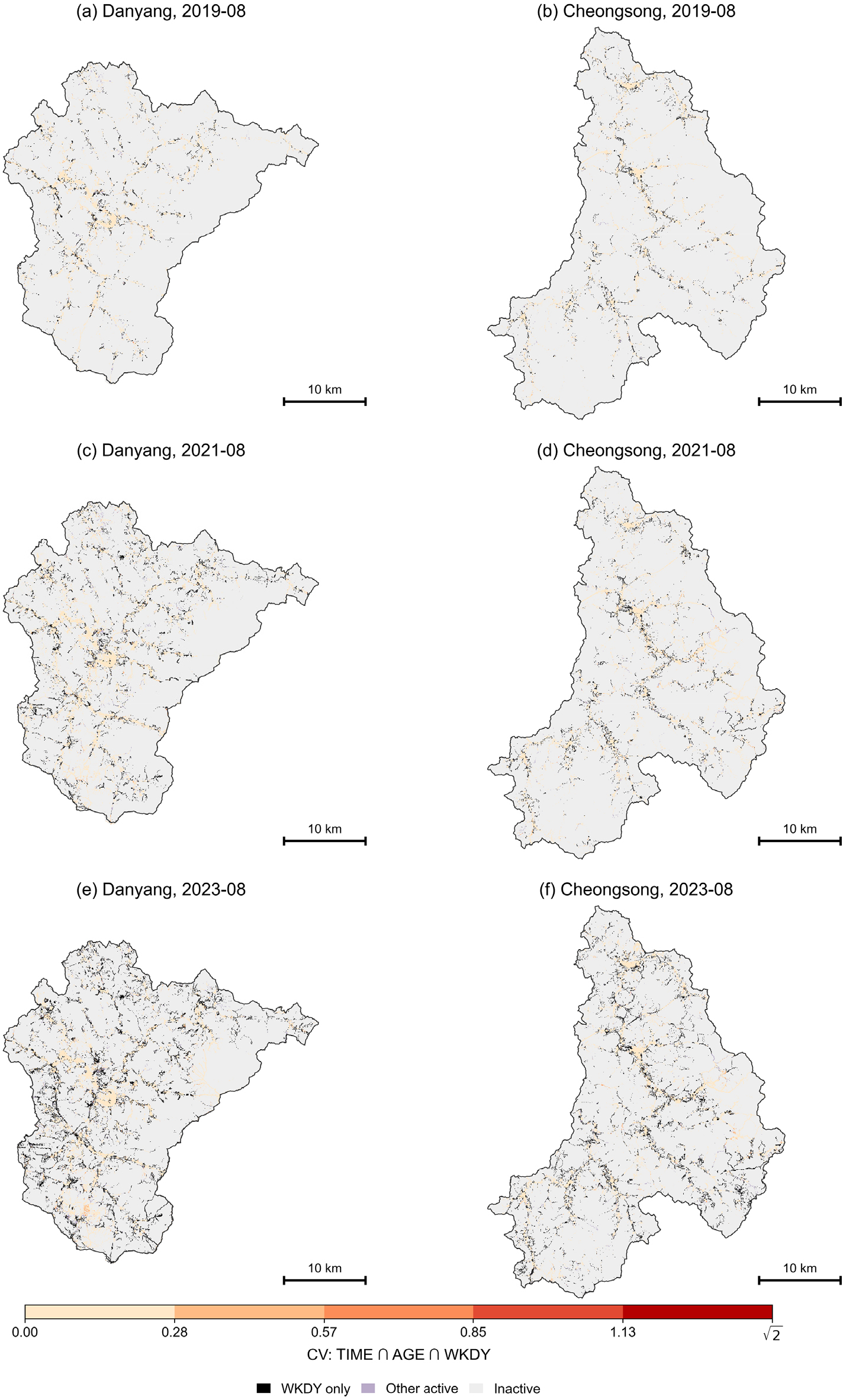
- This study examines consistency among floating population datasets derived from the same underlying mobile network data using different aggregation criteria and identifies considerations for their use. Hourly, day-of-week, and sex- and age-specific datasets on a 50m×50m grid for 2019–2023 in Danyang-gun and Cheongsong-gun were used to analyze spatial coverage, regional totals, discrepancies in cell-level values, and their relationships with local characteristics. The findings were as follows. First, regional totals were broadly similar across the three datasets, but the day-of-week dataset had the widest spatial coverage, and the proportion of cells with positive values only in this dataset generally increased over time. Second, pairwise comparisons restricted to cells with positive values in both datasets showed that the hourly and day-of-week datasets had relatively similar value distributions, whereas differences involving the sex- and age-specific dataset were more pronounced. Relative discrepancies among the three datasets were greater in cells with lower floating population estimates and exhibited positive spatial autocorrelation. Third, associations between relative discrepancies and local characteristics weakened or changed direction after controlling for floating population size. These findings highlight the need to distinguish between spatial coverage and differences in values when using these datasets according to the purpose of the analysis.
- COLLAPSE
본 연구는 동일한 이동통신 원자료에서 집계 기준을 달리하여 산출된 유동인구 자료 간 일관성을 검토하고, 자료 활용 시 고려해야 할 사항을 제시하는 것을 목적으로 한다. 이를 위해 단양군과 청송군의 2019~2023년 50m×50m 격자 기반 시간대별, 요일별, 성·연령대별 자료를 활용하여 유동인구의 공간적 분포 범위와 지역 단위 총량, 셀 단위 값의 편차 및 지역 특성과의 관계를 분석하였다. 분석 결과, 첫째, 세 자료의 지역 단위 총량은 대체로 유사하였으나, 요일별 자료의 공간적 분포 범위가 가장 넓었으며, 이 자료에서만 양의 값을 갖는 셀의 비중이 전반적으로 증가하였다. 둘째, 자료쌍별로 두 자료 모두 양의 값을 갖는 셀의 값 분포를 비교하면, 시간대별과 요일별 자료가 상대적으로 유사하고 성·연령대별 자료와의 차이가 두드러졌다. 또한 세 자료 간 상대편차는 유동인구 규모가 작을수록 높았으며, 양의 공간적 자기상관을 보였다. 셋째, 상대편차와 지역 특성 간 관계는 유동인구 규모를 통제하면 약화되거나 방향이 바뀌었다. 이러한 결과는 분석 목적에 따라 유동인구의 공간적 분포 범위와 값의 차이를 구분하여 자료를 활용할 필요가 있음을 보여준다.
-
Analyzing Consistency among Types of Mobile Network-Based Floating Population Data: A Case Study of Danyang-gun and Cheongsong-gun
-
Research Article
-
A Study on Long-Term Changes and Spatial Reorganization of Grade-1 Zones in the Ecological and Natural Map of Gangwon State: A Comparison of 2007 and 2026
강원지역 생태·자연도 1등급 권역의 장기 변화와 공간적 재편에 관한 연구: 2007년과 2026년의 비교
-
Hye-Yeon Yoon ⋅ Wooseok Oh
윤혜연 · 오우석
- This study analyzed the long-term changes in area and spatial reorganization of grade-1 zones in the ecological and natural map of gangwon …
본 연구는 2007년과 2026년 생태·자연도 1등급 권역을 대상으로 강원지역의 장기적인 면적 변화와 공간적 재편 특성을 분석하였다. 강원지역 18개 시·군별 1등급 면적률 변화를 …
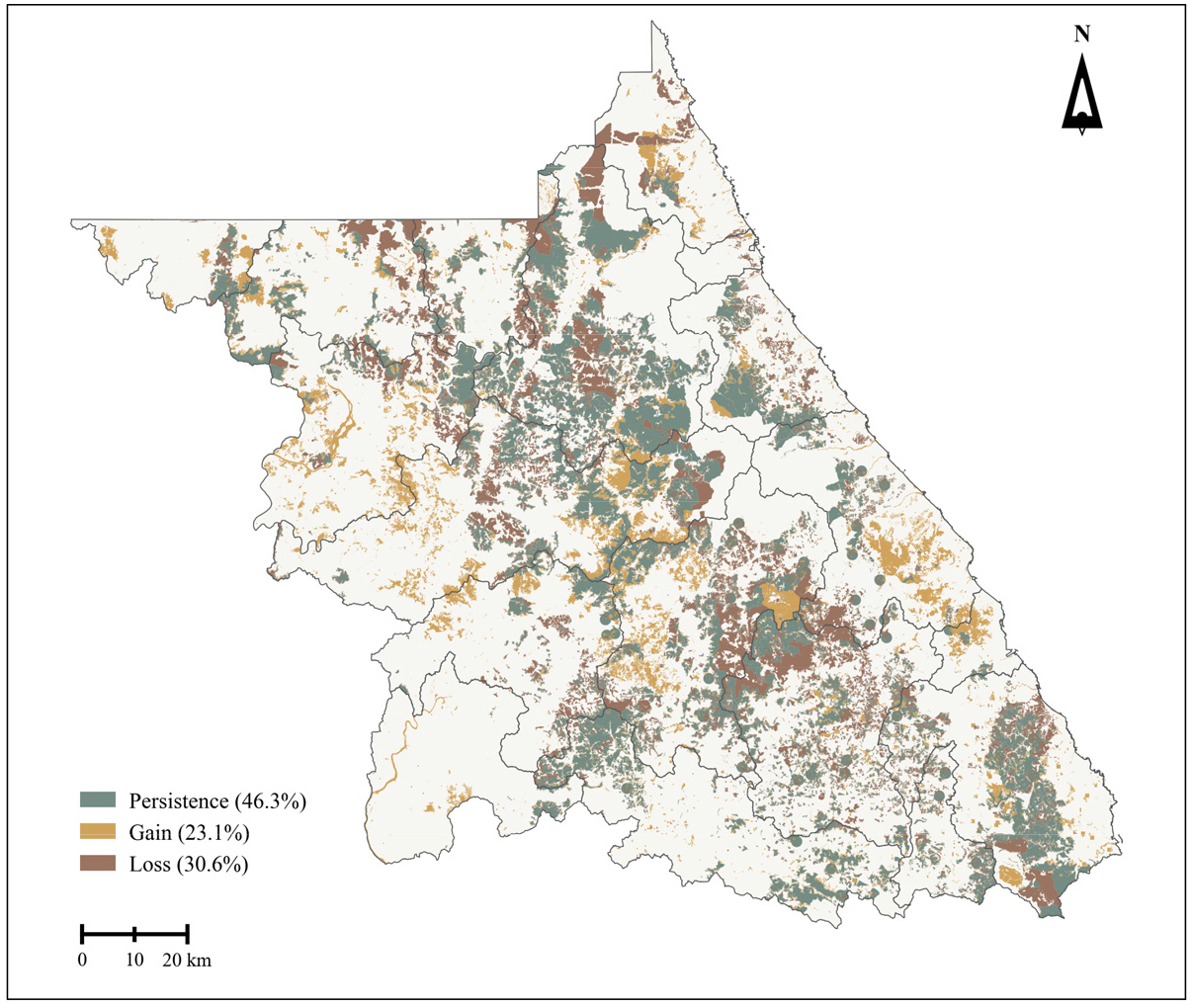
- This study analyzed the long-term changes in area and spatial reorganization of grade-1 zones in the ecological and natural map of gangwon state, by comparing data from 2007 and 2026. Changes in the proportion of grade-1 zones were calculated for 18 municipalities, and spatial overlay analysis was conducted to identify persistence, gain, and loss areas. Persistence rate and Jaccard similarity were then used to evaluate the degree of spatial change. The results showed that the total area of grade-1 zones decreased by approximately 9.8%, from 3,901.7km2 in 2007 to 3,519.6km2 in 2026, with an overall persistence rate of 60.2% and a Jaccard similarity of 0.463. The Wilcoxon signed-rank test indicated no significant difference in municipal grade-1 zone ratios between the two years (p=0.284), whereas the Spearman rank correlation was high (ρ=0.829, p<0.001). In addition, the municipalities were classified into four long-term change types based on changes in grade-1 zone ratios and Jaccard similarity. These results indicate that long-term changes in grade-1 zones should be evaluated by considering not only changes in area but also the persistence of the same spatial locations and the degree of spatial reorganization.
- COLLAPSE
본 연구는 2007년과 2026년 생태·자연도 1등급 권역을 대상으로 강원지역의 장기적인 면적 변화와 공간적 재편 특성을 분석하였다. 강원지역 18개 시·군별 1등급 면적률 변화를 산정하고, 공간중첩을 통해 유지지역, 신규 편입지역 및 1등급 제외지역을 구분하였으며, 유지율과 Jaccard 공간유사도를 활용하여 공간변화 정도를 평가하였다. 분석 결과, 1등급 권역은 2007년 3,901.7km2에서 2026년 3,519.6km2로 약 9.8% 감소하였으며, 전체 유지율은 60.2%, Jaccard 공간유사도는 0.463으로 나타났다. Wilcoxon 부호순위 검정에서는 두 시점 간 시·군별 면적률의 유의한 차이가 나타나지 않았으나(p=0.284), Spearman 순위상관은 높게 나타났다(ρ=0.829, p<0.001). 또한 면적률 변화와 Jaccard 공간유사도를 바탕으로 시·군을 네 가지 장기 변화유형으로 구분하였다. 도출된 결과는 생태·자연도 1등급 권역의 장기 변화를 평가할 때 면적 증감뿐만 아니라 동일 공간의 유지와 공간적 재편을 함께 고려할 필요가 있음을 보여준다.
-
A Study on Long-Term Changes and Spatial Reorganization of Grade-1 Zones in the Ecological and Natural Map of Gangwon State: A Comparison of 2007 and 2026
-
Research Article
-
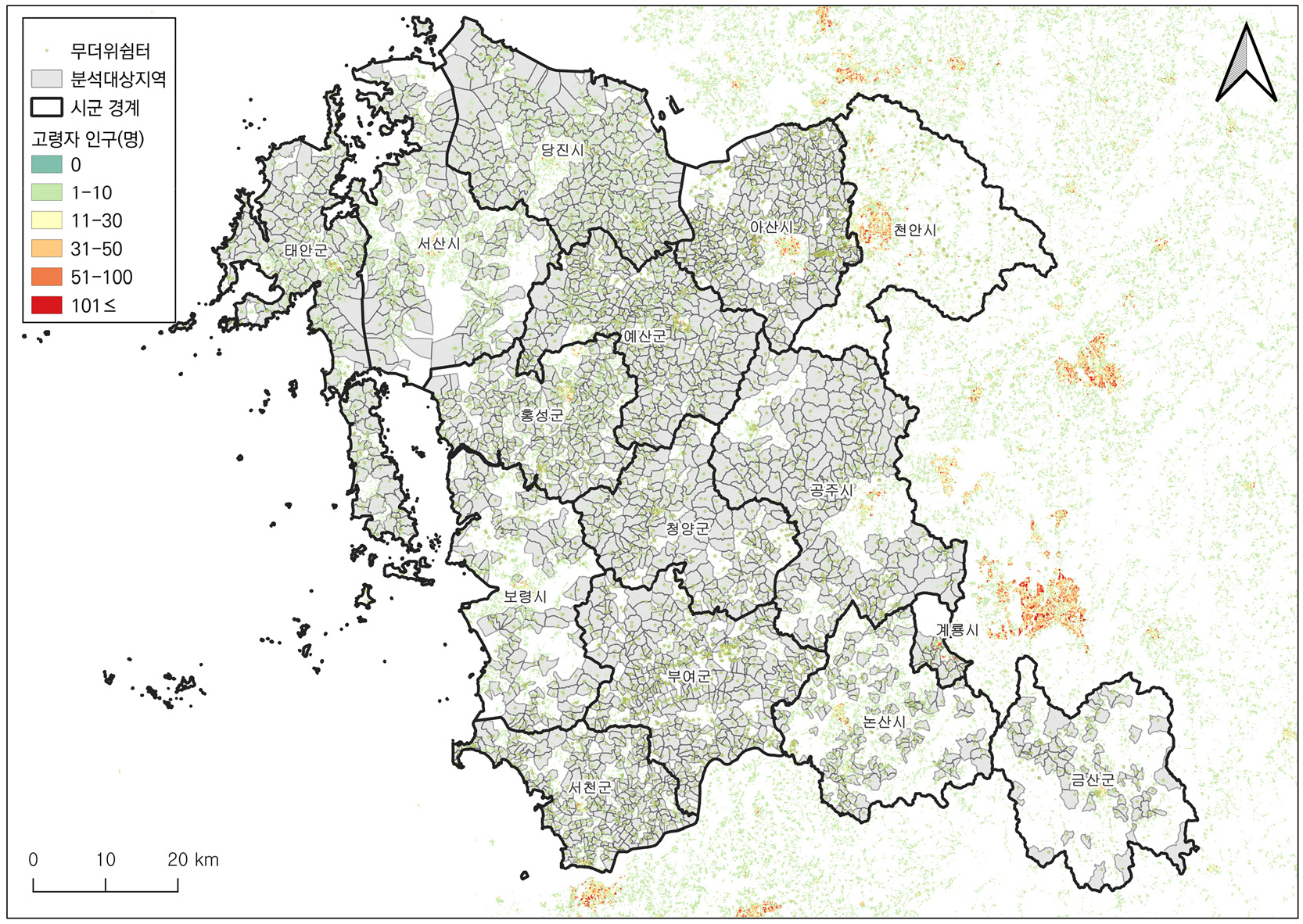
Accessibility and Service Blind Spots of Rural Heatwave Shelters under Social Boundaries and Settlement Structures: Evidence from Older Adults in Chungcheongnam-do
사회적 경계와 정주구조를 반영한 농촌 무더위쉼터 접근성과 서비스 사각지대 분석: 충청남도 고령자 사례를 중심으로
-
Seohyeon Lee ⋅ Hayoung Lee ⋅ Sock-Ho Jeong ⋅ Jongchul Park
이서현 · 이하영 · 정석호 · 박종철
- As climate change intensifies, heatwaves are becoming an increasing health threat to the elderly population in rural areas. Most rural heat shelters …
기후변화의 심화에 따라 폭염은 농촌 지역 고령 인구에게 점증하는 건강 위협으로 작용하고 있다. 농촌 무더위쉼터는 대부분 마을회관을 중심으로 운영되며, 물리적으로 더 가까운 …
- As climate change intensifies, heatwaves are becoming an increasing health threat to the elderly population in rural areas. Most rural heat shelters are operated centered around village halls, and even if a shelter exists in a neighboring administrative village that is physically closer, residents tend to use the shelter within their own administrative village. Therefore, the existing conventional distance-based accessibility may overestimate the actual level of service in rural areas. This study compared the differences in accessibility evaluation results according to whether the administrative-neighborhood boundaries of Chungcheongnam-do were reflected, and analyzed the structural factors that lead to service blind spots. Service blind spots were closely related to structural spatial characteristics such as dispersed settlement patterns. These results show that accessibility to rural cooling shelters is not merely a matter of distance, but rather a community-based service issue that is shaped by the complex interplay of social boundaries and structural spatial characteristics. Future heatwave response policies need to shift away from quantitative expansion focused on the number of facilities and adopt tailored strategies that take into account residential structures and regional accessibility characteristics.
- COLLAPSE
기후변화의 심화에 따라 폭염은 농촌 지역 고령 인구에게 점증하는 건강 위협으로 작용하고 있다. 농촌 무더위쉼터는 대부분 마을회관을 중심으로 운영되며, 물리적으로 더 가까운 인접 행정리에 쉼터가 존재하더라도 주민들은 자신이 속한 행정리 내의 쉼터를 이용하는 경향이 있어 기존의 거리 기반 접근성 평가는 농촌 지역의 실제 서비스 수준을 과대 추정할 가능성이 있다. 본 연구는 충청남도 행정리 경계 반영 여부에 따른 접근성 평가 결과의 차이를 비교하고, 서비스 사각지대의 구조적 형성 요인을 분석하였다. 서비스 사각지대는 분산된 정주 형태와 같은 구조적 공간 특성과 밀접하게 관련되었다. 이러한 결과는 농촌 무더위쉼터 접근성이 단순한 거리 문제가 아니라 사회적 경계와 구조적 공간 특성이 복합적으로 작용하는 생활권 기반 서비스 문제임을 보여준다. 향후 폭염 대응 정책은 시설 수 중심의 양적 확충에서 벗어나, 정주구조와 지역별 접근성 특성을 고려한 맞춤형 대응 전략으로 전환될 필요가 있다.
-
Accessibility and Service Blind Spots of Rural Heatwave Shelters under Social Boundaries and Settlement Structures: Evidence from Older Adults in Chungcheongnam-do
-
Research Article
-
Changes in the Transportation Route Between Jeonju and Samrye Section
전주 ~ 삼례 구간의 교통로 변화
-
Sungwook Cho
조성욱
- In this study, the transportation route from Jeonju Castle to Samrye Station in the Joseon Dynasty was identified, and regional changes were …
이 연구에서는 조선시대 전주부성 ~ 삼례도찰방 간의 교통 노선을 확인하고, 1908년 전주 - 군산 간 신작로 개설 이후 나타난 교통로 변화와 그에 …
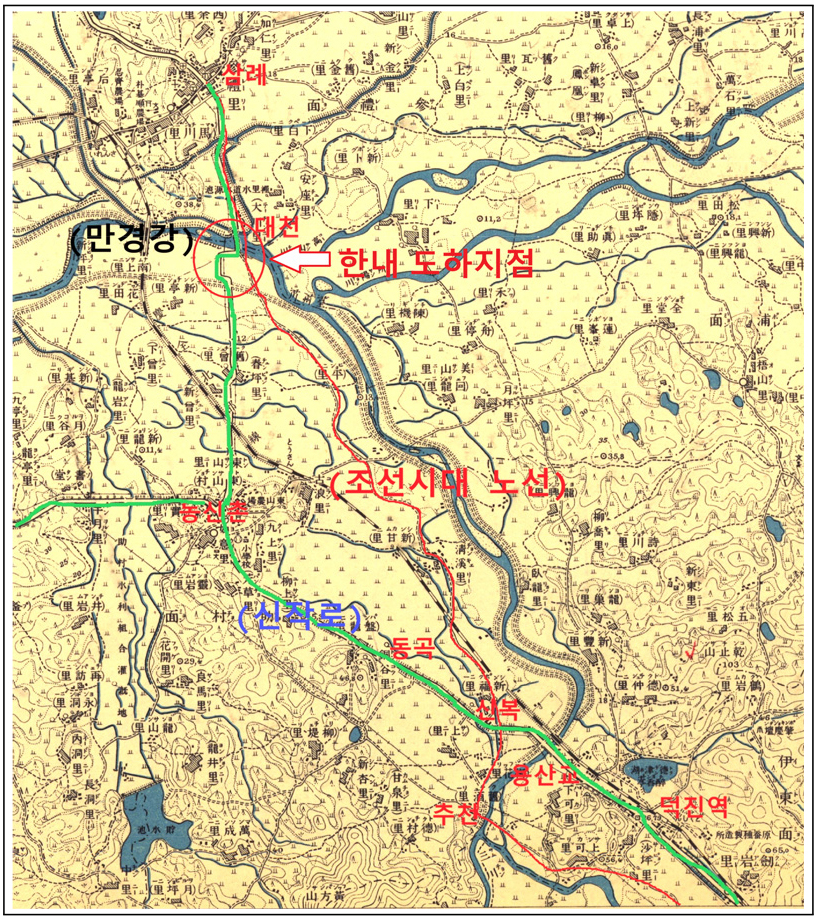
- In this study, the transportation route from Jeonju Castle to Samrye Station in the Joseon Dynasty was identified, and regional changes were examined according to the change of transportation routes after the opening of a new road between Jeonju and Gunsan in 1908. As a result of dividing the transportation route into three sections, first, the main route from West gate to Chucheon seems to have been used; West gate ~ Gongbuk jeong ~ Sup jeong ~ Sanggari ~ Chucheon in the Joseon Dynasty. In this section, new roads (Jeonju-Gunsan) have been opened since 1908, and the routes have changed to Joseon route, Taepyeong route, Paldal route and the cross point of Jeonju Stream has also changed from Chucheon to Yongsan Bridge. Second, the Chucheon ~ Hannae section used a route from the Joseon Dynasty to the Chucheon ~ Donggok-ri ~ Dongsan-ri ~ Gorang-ri ~ Hannae. In this section, regional changes were significant due to changes in transportation routes, such as the change of the route in 1908, and the change of the road junction from Guju Village to Dongsan Village. Third, the section between Hannae and Samrye Station was a line that connects Hannae ~ Daecheon Village ~ Chalbang bridge ~ Samrye Station. In this section, there were regional changes such as the Mangyeong river railway bridge and the change of the center of Samrye Town due to railroad station.
- COLLAPSE
이 연구에서는 조선시대 전주부성 ~ 삼례도찰방 간의 교통 노선을 확인하고, 1908년 전주 - 군산 간 신작로 개설 이후 나타난 교통로 변화와 그에 따른 지역변화를 살펴보았다. 전주부성 ~ 삼례도찰방 사이의 교통로를 3개 구간으로 나누어 살펴본 결과, 첫째, 전주부성 서문 ~ 추천 노선에서는 조선시대에 서문 ~ 공북정 ~ 숲정이 ~ 상가리 ~ 추천 노선이 주요 노선으로 이용된 것으로 보인다. 이 구간에서는 1908년 이후 신작로 개설(전주-군산)로 조선시대길, 태평로, 팔달로 등으로 노선 변화가 나타났으며, 전주천의 도하 지점도 추천에서 용산교로 변화했다. 둘째, 추천 ~ 한내 구간에서는 조선시대에 추천 ~ 동곡리 ~ 동산리 ~ 고랑리 ~ 한내로 연결되는 노선이 이용되었다. 이 구간에서는 1908년 신작로 개설에 의한 노선의 변화, 군산 및 삼례 방면의 도로 분기점이 구주 마을에서 동산촌으로 변화하는 등 교통 노선의 변화에 따른 지역변화가 크게 나타났다. 셋째, 한내 ~ 삼례도찰방 구간에서는 조선시대에 한내 ~ 대천마을 ~ 찰방다리 ~ 삼례도찰방으로 연결되는 노선이었다. 이 구간에서는 만경강 철교, 철도역에 의한 삼례읍의 중심지 변화가 있었다.
-
Changes in the Transportation Route Between Jeonju and Samrye Section

Journal Informaiton
 Journal of the Association of Korean Geographers
Journal of the Association of Korean Geographers






 The Association of Korean Geographers
한국지리학회
105, Academic Affairs Office, 1st floor, College of Education, Dongguk University, Hakrim Hall (J Building), 30, Pildong-ro 1-gil, Jung-gu, Seoul 04620, Korea
Tel: +82-2-2260-3108 / Fax: +82-2-2260-3113 / E-mail: geography.akg@gmail.com Copyright© The Association of Korean Geographers. Powered by APUB
Tel: +82-2-2260-3108 / Fax: +82-2-2260-3113 / E-mail: geography.akg@gmail.com Copyright© The Association of Korean Geographers. Powered by APUB